
Can I use PVC edge banding on curved surfaces?
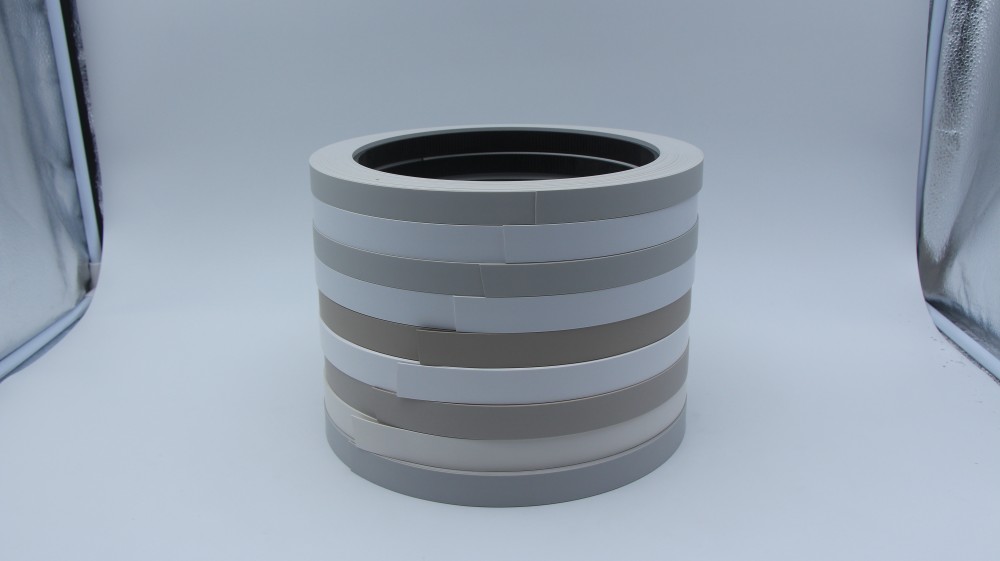
Yes, you can use PVC edge banding on curved surfaces, but it requires specific conditions regarding thickness, material formulation, and processing techniques.
Standard thick edge banding (1mm+) is too rigid to bend without cracking. For curves, you need to follow these guidelines:
1. The "Thickness" Rule
- Concave Curves (Inward curves, like the front of a drawer):
- Maximum recommended thickness: 0.8mm.
- Ideal thickness: 0.4mm - 0.5mm.
- Thicker material (1mm+) will crack or require excessive heat that destroys the glue.
- Convex Curves (Outward curves, like a rounded tabletop edge):
- Maximum recommended thickness: 0.8mm - 1.0mm.
2. The "Material" Rule: Pre-glued vs. Flexible Grade
Not all PVC is created equal for bending.- Pre-glued Edge Banding:
- Risk: Most standard pre-glued edge banding uses EVA hot melt glue. If you apply heat to bend the PVC, the glue melts and becomes unusable.
- Solution: If you must use pre-glued, look for brands that use thermoplastic glue (rare) or be prepared to scrape off the melted glue and apply new glue manually.
- Flexible Grade PVC:
- Some manufacturers produce specific "Flexible PVC" or "Post-forming PVC" which contains higher levels of plasticizers to make it softer and more bendable at room temperature.
- Use a household iron (set to low/wool setting) without steam.
- Heat the edge banding while pressing it onto the curve.
- Remove Pre-glue: If the edge banding has a hot-melt glue strip, remove it first (it will just melt and make a mess).
- Heat the PVC: Using a heat gun (set to low/medium) or a hairdryer, warm the back of the edge banding.
- Warning: Do not overheat the front (surface), or you will burn the texture.
- Test Flexibility: Once heated, the PVC becomes very soft. Test the bend radius.
- Apply Contact Cement: Since hot-melt glue guns don't work well on curves (you can't clamp it), use Contact Cement (apply to both the board and the PVC, let dry, then press).
- Clamp: Use strap clamps or tape to hold the edge banding tight against the curve while the cement sets.This requires skill to keep the curve smooth without wrinkles.
3. Processing Techniques (How to do it)
There are three main methods to apply PVC to curves:A. The Hairdryer/Heat Gun Method (Manual)
Best for DIY or small shops.
B. The Iron-On Method (DIY with specific glue)
Some edge banding comes with a special glue that activates at lower temperatures.
C. Automatic Post-Forming Machine (Industrial)
For factories producing curved countertops or furniture.- Continuous Heat: The machine uses infrared heaters to soften the PVC.
- Vacuum or Pressure: The machine presses the soft PVC onto the curve using pressure rollers or vacuum forming.
- Cooling: It immediately cools the PVC to lock the shape in place.
4. Common Problems and Solutions
Problem Cause Solution Cracking (Stress Whitening) PVC is too thick or not heated enough. Switch to 0.4mm thickness. Heat the PVC more evenly. Wrinkles/Bubbles The curve is too tight for the material. Use Contact Cement and stretch the PVC slightly as you apply it. Ensure the radius is no tighter than the material allows. Glue Failure Hot-melt glue cools too fast on curves. Never use hot-melt glue sticks for curved edges. Always use Contact Cement. Edge Lifting The PVC is trying to "spring back" to its original shape. Use thicker clamps or more tape. Use "Flexible Grade" PVC which has better memory retention.
- Pre-glued Edge Banding: